The Flock Safety Guide: Who Watches, and How to Check
Reviewed 30 July 2026 · Sources checked quarterly TAKE THIS TO A MEETING A 4-page printable version, with the records request template, formatted for handing out. DOWNLOAD THE PDF PRINT THIS PAGE Flock Safety is the largest provider of automated license plate reader cameras in the United States. Most people who drive past one every […]
Reviewed 30 July 2026 · Sources checked quarterly

Flock Safety is the largest provider of automated license plate reader cameras in the United States. Most people who drive past one every day have never heard the company’s name. This guide explains, with sources, how Flock grew, why it grew so fast, where the hardware comes from, who built the software, and, after each section, exactly what you can do with that information in your own town. No opinion required: every step below is a public process available to any resident, and every claim links to its source at the bottom of the page.
Company figures in this guide (revenue, valuation, camera counts) are drawn from Flock’s own announcements, regulatory filings, and investor-oriented reporting, and are labeled as company-reported where independent confirmation is not available. Figures current as of July 2026. See something wrong? Our corrections policy applies to this page.
Part 1
How big Flock has become
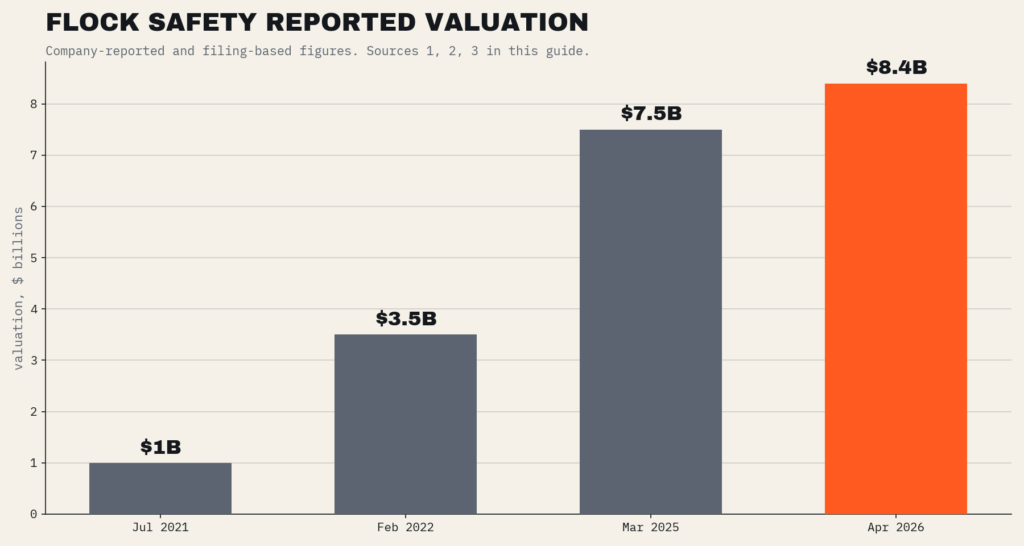
Flock Safety was founded in Atlanta in 2017 after co-founder Garrett Langley experienced a property crime that police could not solve for lack of evidence [1]. Nine years later it is one of the fastest-growing companies in American technology. Around its March 2025 fundraise, the company reported passing $300 million in annual recurring revenue, a 70 percent year-over-year increase, and a $7.5 billion valuation in a round led by Andreessen Horowitz [2]. By April 2026, a publicly filed corporate charter put the valuation at $8.4 billion, with total funding above $1 billion [1][3].
The physical footprint matches the financial one. Researchers estimate 80,000 or more Flock devices deployed across more than 5,000 communities in 49 states, capturing billions of vehicle scans per month [4]. When third-party cameras integrated into Flock’s software are counted, independent trackers estimate more than 120,000 cameras and connected devices [5]. The company says more than 5,000 law enforcement agencies use its products [6]. At the same time, dozens of cities have suspended or ended contracts after public debate, while others have renewed [6]. Whether to keep, modify, or end a contract is a live decision in city halls across the country right now, which is the reason this site tracks renewal dates.
What you can do: find out if your town is on the network
- Check the maps first. DeFlock maintains a crowdsourced map of known ALPR camera locations, and our own surveillance map overlays contract records on OpenStreetMap camera data. ACLU affiliates in Washington, Iowa, Oregon, and Rhode Island publish state maps [7]. An empty map does not mean no cameras: it means nobody has filed the record yet.
- Search for a transparency portal. In a search engine, type your city’s name plus “Flock transparency portal” [7]. If one exists, note the camera count, the retention period, and which outside agencies data is shared with. These portals are published by the agencies themselves and contain limited detail [8], but they are confirmation that a contract exists.
- Search your council’s records. Go to your city or county website and search past council agendas and minutes for “automated license plate reader,” “ALPR,” or “Flock.” Contracts are often approved inside the consent agenda, a batch of items passed in a single vote with no discussion [7], which is why residents frequently never hear about them.
- Learn to spot the hardware. Flock’s standard camera is a small black box on a metal pole, usually with a solar panel on top, commonly placed at town entrances, main intersections, and school zones [9]. You can photograph one from any public road.
- File the record here. If you confirm a contract, send us the agenda item or contract and we will add your jurisdiction, with your source cited, to the directory.
Part 2
Why it grew so fast
Four structural drivers explain the speed, and none of them is a secret. First, the price. Traditional license plate reader systems cost $20,000 or more per unit and required trenching and wired power. Flock built a solar-powered, cellular camera and sold it as a subscription of roughly $2,000 to $2,500 per camera per year, bundling hardware, installation, maintenance, and software [10]. That put ALPR within reach of a homeowners association budget, not just a police budget.
Second, the go-to-market path. Flock sold to HOAs and neighborhood associations first; as of 2021 they still made up over 40 percent of the business [11]. Private communities installed cameras with no public vote, and police departments were later offered access to that existing private network.
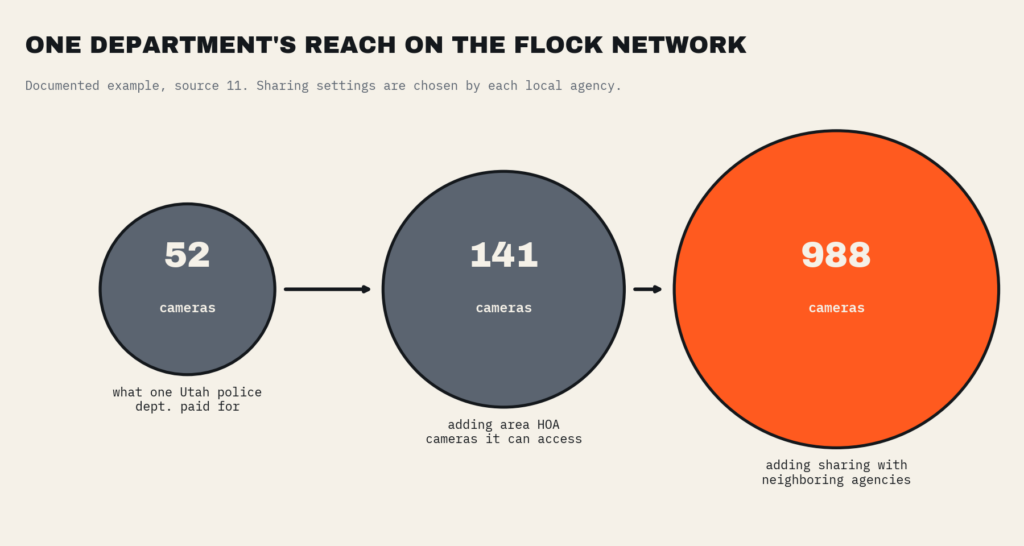
Third, and most important, the network effect. Flock’s system lets agencies opt in to share camera data across jurisdictions. In one documented example, a Utah police department that paid for 52 cameras had access to 141 cameras from area HOAs, and 988 cameras in total through sharing agreements with neighboring departments [11]. Each new customer makes the network more valuable to every existing customer, at low added cost to the company [3]. This is also why a single town’s decision affects its neighbors: the cameras your council approves can be searched by agencies your council never voted on.
Fourth, product expansion. What began as a plate reader is now a platform: video cameras, gunfire detection, drone-as-first-responder units following the 2024 acquisition of Aerodome [12], live 911 call streaming across jurisdictions, and natural-language search of existing camera systems [13].
What you can do: find out who your town’s cameras talk to
- Ask the data-sharing question in public. At a council meeting’s public comment period, or in a written question to your council member, ask: “Which outside agencies can search our Flock data, and is national lookup enabled?” This is a factual question with a yes-or-no answer, and it is the single most revealing question a resident can ask, because sharing settings are configured by the local agency, not by Flock [14].
- If you live under an HOA, you have a second government to ask. Request, in writing, the association’s camera contract, the data retention period, and whether law enforcement access is enabled. HOA boards are typically obligated by state HOA statutes and their own bylaws to make contracts available to members. Camera decisions can be placed on the agenda of your annual meeting and voted on like any other association matter.
- Ask about the renewal date. Every Flock relationship is a subscription that comes up for renewal [10]. Ask your clerk when the current term ends and whether renewal requires a council vote. Then check our jurisdictions directory, and if your town’s renewal date is missing, send it in.
- Request the sharing configuration in writing. A public records request for “the current list of external organizations with access to the agency’s Flock Safety network, including any national lookup settings” turns a verbal answer into a document. Template in Part 5.
Part 3
Where the hardware is made
The accurate answer is: assembled and serviced in Georgia, built from globally sourced components. In April 2025 Flock opened a 97,000-square-foot manufacturing facility in Smyrna, Georgia, an approximately $10 million investment expected to create an estimated 210 jobs over three years [15]. The site produces the company’s drones and solar panels and serves as its U.S. repair and refurbishment hub [16][12].
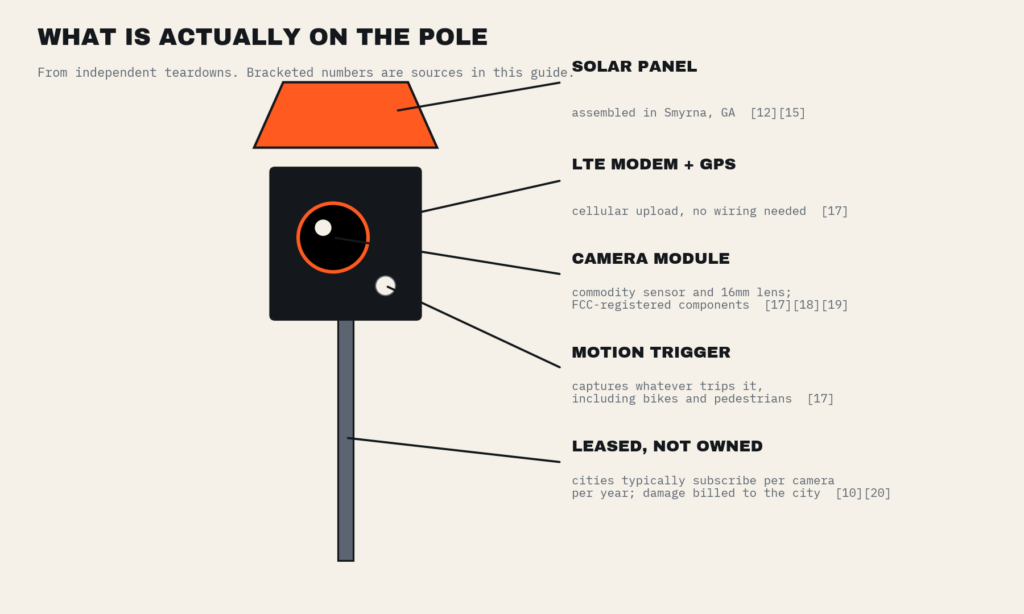
Independent teardowns document what is inside the cameras themselves. The Center for Human Rights and Privacy dissected a Flock camera and identified a NimbeLink LTE modem, a PHD Energy lithium-ion battery, a Lantronix system-on-module, LITE-ON wireless components, a Taoglas GPS antenna, and a commodity 16mm camera lens [17]. A public reverse-engineering project on GitHub documents a newer unit’s main board, LED board, and Sony sensor-based camera module, with a full chip and FCC ID inventory [18]. FCC filings show at least one camera model in the Flock ecosystem registered to a Shenzhen-based original design manufacturer [19]. None of this is unusual for electronics, and we note that Flock markets its drones as NDAA-compliant and U.S.-made [19]; the point for a resident is simply that “where is it made” has a documented, checkable answer, and that the physical device is ordinary hardware. What is distinctive about Flock is the software network, which is the subject of the next section.
What you can do: get the procurement record
- Request the contract itself. File a public records request with your city or county clerk for “all current agreements, statements of work, and purchase orders between [jurisdiction] and Flock Safety or Flock Group Inc.” The contract shows the per-camera price, the term length, the renewal terms, and who owns the data.
- Check how it was purchased. Ask whether the contract went through competitive bidding or a cooperative purchasing agreement. Cooperative purchasing is legal and common, but it means no local bid comparison happened, which is a fair procurement question for any vendor.
- Ask who pays when a camera is damaged or fails. Cities generally lease rather than own the hardware, and replacement costs appear as line items to the city [20]. The contract’s damage and replacement schedule tells you the real total cost, which is rarely the sticker price quoted at approval.
- Look up the device. Every radio-transmitting device sold in the U.S. has an FCC ID searchable at fcc.report. If you can photograph a label, you can verify the manufacturer of record yourself, no expertise required.
Part 4
Who built the software, and what independent review found
Flock was founded by Georgia Tech alumni: Garrett Langley, an engineer and serial entrepreneur, and Matt Feury, a software specialist, launching the company on March 1, 2017 [10]; Paige Todd is also credited as a co-founder [16]. The signature software claim is “vehicle fingerprint” technology: the company states its system identifies make, model, color, and distinguishing details such as bumper stickers, dents, and temporary plates, allowing searches without a plate number [21]. Flock states that its cameras do not use facial recognition, that every search is logged, and that the system is built for case-based investigation rather than continuous monitoring of individuals [14].
Independent review has found weaknesses. An analysis of Flock Falcon cameras published in 2025 found unlocked bootloaders, debug kernels, and unsecured Wi-Fi in diagnostic mode, flaws that could permit firmware tampering and unauthorized access; the hardware runs a Qualcomm Snapdragon processor with Android 8.1 and custom software [22]. Separately, reporting in 2025 and 2026 documented cases where camera feeds were left accessible to the open internet through misconfiguration [4]. Flock disputes the severity of some findings, arguing that physical access requirements and server-side controls reduce real-world risk [22]. Both the findings and the company’s response are linked in the sources so you can weigh them yourself.
What you can do: check how the software is actually being used in your town
- Search the released audit logs. Have I Been Flocked aggregates search audit logs already released through records requests, searchable by plate and by agency [5], and Eyes On Flock aggregates data from published transparency portals [23]. Start there: your agency’s logs may already be public.
- Understand the two logs that matter. Flock’s system generates an Organization Audit (searches run by your own agency’s users) and a Network Audit (searches of your agency’s cameras by any other agency in the Flock system), both exportable as CSV from the software’s Insights tab [24]. The Network Audit is the one that shows whether distant or federal agencies have been searching your town’s cameras.
- Ask for the agency’s written use policy. Who is authorized to search, what reasons are acceptable, and what happens when a search violates policy. If no written policy exists, that absence is itself a finding your council should hear about, and it is a request any council member of any party can make.
- Know the limits of the public portal. The public-facing “search audit” on transparency portals is a reduced version, showing dates, camera counts, anonymized user IDs, and stated reasons [8]. It is useful for volume and stated purpose, not for full oversight. The full CSV logs come only through a records request, covered next.
Part 5
The records request: the strongest tool a resident has
Every state has a public records law, and the audit logs above are records held by your local agency, not by Flock. Journalists at Santa Cruz Local published a replicable method for requesting them, which we adapt here with their citation [24]. Be aware of what to expect: Flock’s own guidance to agencies on open records requests suggests agencies consider redacting plates, search reasons, and case numbers, narrowing timeframes, and charging fees [8]. Redaction of genuinely sensitive fields can be lawful; a resident who knows the documents exist and asks for them precisely is far harder to turn away.
What you can do: file it this week
- Find the intake. Look for a records request portal on your police department, sheriff, or city clerk website. If none exists, email the city or county clerk directly [24]. Requests can be made by any person; you generally do not need to be a resident or give a reason.
- Use precise language. Copy the template below, filling in your jurisdiction and dates.
- Expect a statutory deadline. Every state sets a response window. If the deadline passes, a polite follow-up citing your state’s records statute usually restarts motion.
- If fees are quoted, ask for the itemization and whether a narrowed date range (for example, the most recent 90 days) reduces the cost. A smaller window that arrives is worth more than a large one that never does.
- Send us what you receive. Released logs, contracts, and policies filed through our contact form get added to the public record here, cited to you or anonymously, as you prefer.
Template request:
Under [state] public records law, I request the following records related to the [city/county]’s Flock Safety automated license plate reader system: (1) the Organization Audit report, available within the Flock software’s Insights tab, covering [start date] to the date this request is processed; (2) the Network Audit report for the same period, reflecting searches of the organization’s Flock network by any agency in the Flock system; (3) all current agreements between [jurisdiction] and Flock Safety, including renewal dates; (4) the agency’s current written ALPR use and data-sharing policy, including the list of external organizations with network access. I request records in their native electronic format (CSV where applicable). Please advise of any fees before processing.
The short version. A company most residents have never heard of operates the largest license plate reading network in the country, growing on a subscription model, a neighborhood-first sales channel, and cross-jurisdiction data sharing that most council members have never been asked to explain. None of the steps in this guide requires a position on whether the cameras should exist. They require only the machinery every American already has: a map, a meeting agenda, a records request, and a renewal date. Find yours in the directory, and if it is not there yet, help us put it there.
Sources
- Sacra, “Flock Safety revenue, funding & growth rate,” accessed July 2026. sacra.com/c/flock-safety
- Flock Safety, “Flock Safety Raises $275M in New Funding at $7.5B Valuation,” March 13, 2025 (company-reported). flocksafety.com/blog/flock-safety-secures-major-funding
- TSG Invest, “Flock Safety Stock: $8.4B,” June 10, 2026. tsginvest.com/flock-safety
- CB Insights investor profile / reporting on exposed camera streams and deployment estimates, accessed July 2026. cbinsights.com/investor/flock2
- Have I Been Flocked, “About,” accessed July 2026. haveibeenflocked.com
- Axios Pro, “Scoop: Flock Safety eyes new fundraising round,” April 13, 2026. axios.com
- ACLU, “Get The Flock Out Toolkit,” accessed July 2026. aclu.org/get-the-flock-out-toolkit
- Have I Been Flocked, “Audit Logs,” citing Flock Safety, “Guide to Flock Safety Data for Open Records Laws” (Sept. 3, 2025). haveibeenflocked.com/about/audit-logs
- Rural Privacy Coalition, “Find Flock ALPR Cameras in Your Area,” accessed July 2026. ruralprivacy.org
- businessmodelcanvastemplate.com, “Brief History of Flock Safety,” March 2026 (secondary source; pricing consistent with contract records).
- Contrary Research, “Flock Safety Business Breakdown & Founding Story,” accessed July 2026. research.contrary.com/company/flock-safety
- Flock Safety, “Flock Expands Georgia Footprint with New Manufacturing Facility,” April 2025 (company-reported). flocksafety.com/blog
- Flock Safety, product pages, accessed July 2026. flocksafety.com/products
- Flock Safety, “Trust” page, accessed July 2026 (company statements). flocksafety.com/trust
- Office of Georgia Gov. Brian P. Kemp, press release, April 2, 2025. gov.georgia.gov
- Police1 / Atlanta Journal-Constitution, “Flock Safety opens drone manufacturing facility in Georgia,” April 2025. police1.com
- The Center for Human Rights and Privacy, “Dissection of Flock Safety Camera,” updated July 12, 2026. cehrp.org
- FlockCamRE, reverse-engineering documentation, accessed July 2026. github.com/kernelstub/FlockCamRE
- Gündoğar, “Vulnerability Assessment of the Flock Safety Surveillance Network,” Medium, Dec. 2025 (FCC filing analysis; analytical conclusions are the author’s).
- IPVM reporting on replacement invoices, via Yahoo News syndication, July 2026.
- Wikipedia, “Flock Safety,” accessed July 2026 (with underlying citations). en.wikipedia.org/wiki/Flock_Safety
- IPVM, “Flock Falcon Vulnerabilities Examined (Public Report),” June 2025, covering DeFlock’s analysis and Flock’s response. ipvm.com/reports/dissecting-flock
- Eyes On Flock, accessed July 2026. eyesonflock.com
- Santa Cruz Local, “How is your police department using Flock surveillance data?”, June 19, 2026. santacruzlocal.org
This guide states facts with sources and links to Flock Safety’s own published positions where they respond to independent findings. It does not advise for or against any contract. Corrections: contact us and we will review and note any change on this page.